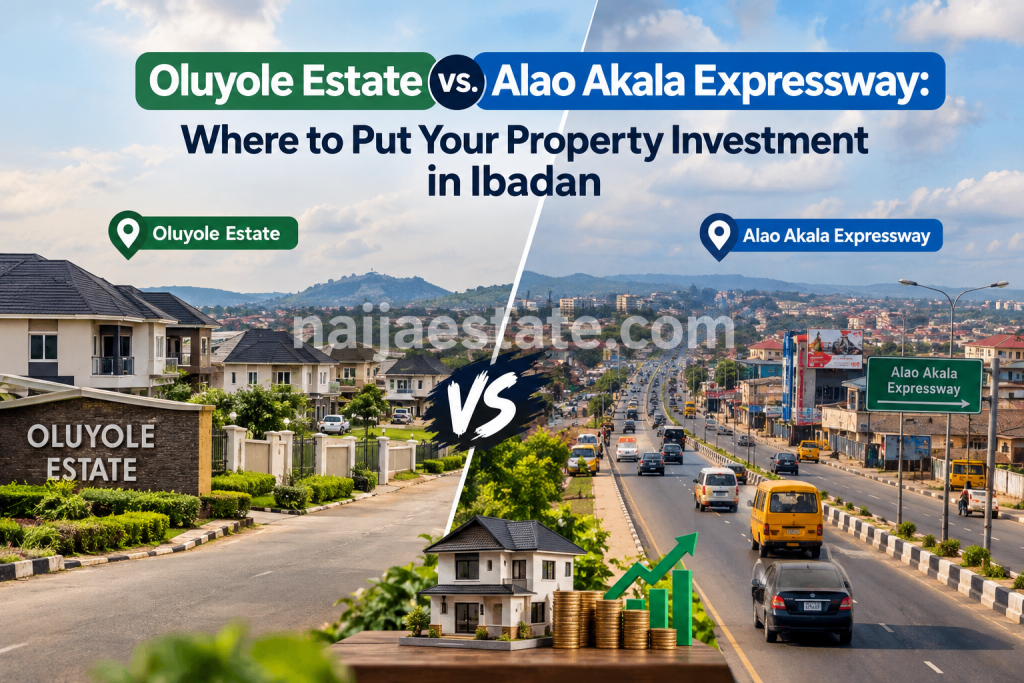
Oluyole Estate vs. Alao Akala Expressway: Where Should You Invest in Ibadan?
Choosing between Oluyole Estate and the Alao Akala Expressway corridor is not simply a question of which location has the most expensive land. It is about understanding where your money can work harder, which properties are likely to attract tenants, and how to avoid buying land that becomes difficult to develop or resell.
For anyone researching the ibadan property market Oluyole Estate vs Alao Akala Expressway, the important distinction is between established neighbourhoods and individual investment opportunities along a developing or busy road corridor. Both can be worth investigating, but the right choice depends on your budget, investment timeline, intended property type and tolerance for risk.
In this guide, we examine the two locations from a practical Nigerian property-investment perspective, including asking prices, rental income, road access, title verification, drainage, hidden costs and the questions to ask before transferring your money to a seller.
1. Understanding the Two Investment Locations in Ibadan
Before comparing prices, let us clarify what these locations represent.
Oluyole Estate is a recognised property and business district in Ibadan, with residential, commercial and industrial land uses in different parts of the wider area. The name covers properties that can differ considerably in access roads, neighbourhood quality, drainage and permitted use.
Alao Akala Expressway, commonly advertised by property platforms as Akala Expressway, is a road-oriented property corridor associated with several neighbourhoods and estates. Listings extend into places such as Ayegun-Oleyo, Kuola, Elebu and Oluyole Extension. These locations should not be treated as one uniform estate.
That distinction matters because a plot advertised as being “along Akala Express” may actually sit several turns inside a developing estate. Its price, accessibility and resale prospects may differ from a plot directly facing the main road.
Similarly, two plots described as being in Oluyole Estate may have very different investment characteristics. One might sit on a well-maintained street among occupied homes, while another could be near an industrial activity or a low-lying area with drainage problems.
The real comparison is not just Oluyole versus Akala Expressway. It is the exact property, its surrounding environment, its legal status and the income it can realistically produce.
Why Ibadan deserves attention from property investors
Ibadan attracts people with different housing needs: civil servants, traders, business owners, professionals, students, families and people who prefer living outside the more expensive property markets of Lagos.
However, demand is not evenly distributed. A property close to a tenant's workplace, transport routes, schools, shops and other daily necessities may be more attractive than a cheaper house that requires a difficult commute.
For investors, this means that buying in a familiar or fashionable location is not enough. You must identify the people who would actually pay to live in, work in or operate a business from your property.
2. What Current Asking Prices Tell Us About the Ibadan Property Market
A useful starting point is to examine active listings, while remembering that asking prices are not the same as completed transactions.
As of October 2026, Nigeria Property Centre's listings for land on Akala Expressway reported an average asking price of approximately ₦15 million across 23 listed properties. Its results include different property sizes, land uses and neighbourhoods.
For Oluyole Estate, Private Property Nigeria displayed residential plots, larger mixed-use parcels and commercial or industrial land at widely differing prices. Examples included a 600-square-metre plot advertised for ₦60 million, a 484-square-metre plot advertised for ₦80 million and a larger mixed-use parcel advertised for ₦560 million.
These are individual advertised prices, not independently verified valuations. They should not be used as proof that every plot in Oluyole costs tens of millions or that every Akala Expressway plot can be bought for ₦15 million.
A snapshot of advertised land prices
Published property listings checked in October 2026. Prices are asking prices and may change.
Akala Expressway
₦15m
Reported average asking price across 23 land listings on Nigeria Property Centre.
Oluyole Estate
₦60m
One advertised example: a 600-square-metre plot. This is not an area-wide average.
Why the figures need careful interpretation
The apparent difference between these figures does not prove that Oluyole is always more expensive or that Akala Expressway offers better value.
The Oluyole figure is one plot's asking price, while the Akala Expressway figure is a portal-reported average across a collection of listings. The samples may differ in size, title documentation, road frontage, infrastructure and permitted use.
To make a fair comparison, request prices for at least three properties with similar characteristics in each area:
Comparable plot sizes, such as 500–600 square metres.
Similar title documentation and acquisition status.
Similar road access and distance from a major route.
Comparable drainage, electricity and neighbourhood development.
The same intended use: residential, commercial or mixed-use.
Then compare the total acquisition and development costs, rather than the advertised land price alone.
3. Oluyole Estate: Is It the Better Place for Long-Term Property Investment?
Oluyole Estate deserves consideration when your investment strategy depends on the specific residential, commercial or industrial activity surrounding a property.
Its attraction is not that every property automatically commands a premium. It is that the wider area contains different types of property opportunities, making it possible to investigate locations suited to distinct investment objectives.
Advantages of investing in Oluyole Estate
1. Established surroundings in selected neighbourhoods
Some streets have existing residential or business activity. Where homes are occupied and roads are usable, an investor may be able to assess real demand instead of relying entirely on promises about future development.
During an inspection, check whether nearby buildings are occupied, whether shops attract customers and whether residents can access transport and everyday services conveniently.
2. Options beyond ordinary residential land
Oluyole listings include commercial and industrial parcels as well as residential plots. This gives investors a wider range of possible property strategies, provided the specific plot's approved use, access and planning requirements support the intended development.
For example, an appropriately located parcel might suit a family home, rental apartments, a warehouse or a commercial facility. These are different investments with different costs and risks; one parcel should not be assumed suitable for all of them.
3. Potential demand from households and businesses
An established neighbourhood can offer a clearer picture of local demand. You can speak with landlords, tenants, shop operators and property managers to establish which accommodation types are moving and what prospective occupants are willing to pay.
Still, proximity to business activity does not guarantee rental income. Noise, traffic, pollution, security and a shortage of convenient access can make some properties less attractive to residential tenants.
What could make Oluyole Estate a poor investment?
An attractive location name cannot rescue a poorly selected plot.
Potential disadvantages include:
A high purchase price that leaves too little money for construction.
Heavy traffic or inconvenient access to the exact street.
Poor drainage or a history of water entering buildings.
Nearby industrial activity that conflicts with residential use.
Title disputes, acquisition issues or restrictions on development.
Competition from newer properties offering better layouts or facilities.
Suppose an investor pays a premium for land expecting to build luxury rental apartments. If the surrounding area mainly attracts tenants looking for affordable accommodation, the investor may struggle to charge enough rent to justify the construction cost.
This is why property investment should begin with the likely occupant or customer, not with the seller's description of the land as “prime.”
Who should consider Oluyole Estate?
Oluyole may suit investors who:
Want to build a family home in a suitable residential street.
Have a commercial or industrial project with clearly defined requirements.
Prefer to investigate areas where some neighbouring development already exists.
Can afford the acquisition and construction costs without exhausting their reserves.
Are prepared to verify planning rules, title and site conditions before committing.
The best candidate is not necessarily the most expensive plot. It is the one whose location, legal status and development potential match the investor's plan.
4. Alao Akala Expressway: Can a Road Corridor Deliver Better Value?
For investors with a smaller budget or a longer investment horizon, the Akala Expressway corridor may provide opportunities worth examining.
Listings cover a variety of locations, including estates and residential areas away from the main road. For example, current property advertisements include plots in Ayegun-Oleyo and Kuola, with some advertised in the low tens of millions of naira.
That variety is important. The corridor is not a single price band, and not every property marketed under its name is equally accessible or developed.
Potential advantages of the Akala Expressway corridor
1. A range of entry prices
The advertised options suggest that some properties along or off Akala Expressway may have lower entry prices than particular larger or premium parcels advertised in Oluyole Estate.
That could allow a buyer to acquire land while retaining money for fencing, documentation, site preparation or future construction.
However, a lower entry price only represents value if the land is legally sound, physically suitable and realistically developable.
2. Different levels of development
Some parts of the corridor have occupied estates, existing houses and commercial activity. Other pockets may be less developed.
For a buyer willing to wait, a developing location can offer the possibility of future appreciation. But the outcome depends on actual demand, access improvements, infrastructure delivery and the pace of development.
A proposed road, shopping complex or new estate entrance should not be valued as though it has already been completed. Ask for evidence of the project, its funding and its current implementation status.
3. Opportunities for residential development
Depending on the exact street and target market, investors may investigate plots for bungalows, modest family homes, rental flats or other suitable residential projects.
A property that is affordable to acquire and build may provide a more manageable route into the market than a premium parcel that consumes nearly all the investor's capital.
The key is to check the likely rent and construction cost before purchasing.
The disadvantages investors should not overlook
Developing areas can come with expenses that are not obvious during a brief inspection.
A plot may be cheap because its access road is poor, drainage is incomplete, electricity infrastructure is limited or neighbouring development remains sparse. The buyer could eventually spend substantial money on access, filling, fencing and site preparation.
Also consider the distance from the main expressway. A property advertised as being “off Akala Expressway” may require a long journey along an unpaved road before reaching the main route.
Visit during normal working hours and, if possible, after rainfall. A location that appears peaceful on a dry Sunday afternoon may reveal access or drainage problems during the wet season.
Who should consider Akala Expressway?
The corridor may suit investors who:
Have a defined budget and want to compare different plot sizes.
Can wait for development rather than relying on immediate resale.
Want to build a modest home or rental property.
Have verified the estate's infrastructure obligations and documentation.
Are comfortable assessing the exact neighbourhood rather than buying based on the road's name.
For these buyers, the objective should be to find a well-documented plot at a sensible total cost—not simply the cheapest land on the market.
5. Oluyole Estate vs. Alao Akala Expressway: Which Is Better for Your Investment Goal?
The more useful question is not which location wins in every category, but which one fits your investment plan.
| Investment objective | What to investigate first |
|---|---|
| Building a family home | Residential streets with reliable access, drainage and nearby services in either area |
| Long-term land banking | Verified plots with manageable holding costs and credible demand drivers |
| Rental apartments | Streets where comparable homes already attract suitable tenants |
| Shops or commercial premises | Legal commercial use, road frontage, customer access and parking |
| Industrial or warehouse property | Permitted use, truck access, utilities and environmental suitability |
| Lower initial land budget | Individual Akala Expressway corridor listings, compared with equivalent Oluyole plots |
| Established surrounding development | Specific occupied streets in Oluyole and developed pockets along Akala Expressway |
This is a starting framework, not a claim that every property in one location outperforms every property in the other.
Which location offers better capital appreciation?
Capital appreciation is the increase in a property's market value over time. It is attractive because investors can benefit from a rise in value without necessarily operating a rental business.
But appreciation is difficult to predict, especially for land in a developing neighbourhood.
For example, a plot purchased for ₦15 million would need to reach ₦22.5 million to deliver a 50% increase in its nominal purchase value. That does not mean the investor has made a 50% net profit.
The calculation must account for legal fees, acquisition charges, security, maintenance, taxes where applicable, inflation and eventual selling expenses. The land may also take longer to sell than expected.
Oluyole could be attractive where the purchase price is supported by existing demand and development. An Akala Expressway plot could be attractive where the price is reasonable relative to its infrastructure and development prospects.
Neither location guarantees appreciation. Before buying, compare recent evidence of completed transactions for similar properties, rather than relying only on agents' advertised prices or predictions.
Which location is better for rental income?
Rental income depends on the property, not merely the neighbourhood name.
A modest two-bedroom flat in a convenient residential street may be easier to let than a large luxury house with limited access. Equally, a well-designed commercial property in a suitable location may perform better than residential accommodation in the same vicinity.
Before purchasing land for rental development, ask local property managers:
What type of tenant is actively searching in this neighbourhood?
What rent have comparable properties actually achieved?
How long do suitable properties typically remain vacant?
What facilities do tenants expect at the proposed rent?
What are the recurring security, maintenance and management costs?
Do not base a purchase on the highest rent an agent mentions. Seek several comparable examples and distinguish asking rent from rent that tenants have actually agreed to pay.
6. Rental Yield: Calculate the Numbers Before You Buy
One of the biggest mistakes in Nigerian property investment is focusing on how much a property might sell for in five years while ignoring what it can earn today.
Rental yield provides a simple way to compare investment properties.
The gross rental yield formula is:
For a more useful comparison, include the full acquisition cost and estimate the expenses required to maintain the property.
Illustrative case study: Two hypothetical investments
The following examples are financial illustrations, not verified transactions or forecasts for either neighbourhood. They show how different purchase prices, construction budgets and rents can affect an investment decision.
Investment A: A rental property in Oluyole
Land purchase
₦35,000,000
Construction and finishing
₦45,000,000
Documentation, professional fees and other setup costs
₦5,000,000
Total investment
₦85,000,000
Assumed annual rent
₦6,000,000
Gross rental yield
7.06%
Illustrative calculation: ₦6m ÷ ₦85m × 100.
Investment B: A rental property in the Akala Expressway corridor
Land purchase
₦15,000,000
Construction and finishing
₦45,000,000
Documentation, professional fees and other setup costs
₦5,000,000
Total investment
₦65,000,000
Assumed annual rent
₦4,000,000
Gross rental yield
6.15%
Illustrative calculation: ₦4m ÷ ₦65m × 100.
In this illustration, Investment A produces a higher gross yield despite requiring more capital. Investment B costs less overall, but its assumed rental income is also lower.
That is the point: a lower purchase price does not automatically make a property the better investment.
Do not stop at gross yield
Gross yield excludes expenses. A property owner must also consider:
Repairs and maintenance.
Periods when the property is vacant.
Letting and management fees.
Security and common-area costs, where applicable.
Insurance and applicable taxes or statutory charges.
Unexpected repairs and replacement of fittings.
Suppose Investment A receives ₦6 million in annual rent but incurs ₦1.5 million in annual operating expenses. Its operating income before financing and applicable taxes is ₦4.5 million.
Using the same ₦85 million total cost, that equals approximately 5.29% before financing and tax.
A realistic budget should also include a contingency for construction overruns. If building costs rise or completion is delayed, your eventual yield may be lower than the original estimate.
7. The Hidden Costs of Buying Land in Ibadan
The price on the billboard or WhatsApp advert is rarely the only amount you need to budget for.
Before paying for land in Oluyole or along Akala Expressway, request a complete breakdown of every payment required to acquire, document and develop the property.
Common costs to investigate
1. Legal due diligence
A qualified property lawyer should investigate the seller's right to transfer the property, review the documents and identify possible encumbrances or competing claims.
The fee depends on the complexity and value of the transaction. Obtain a written quotation.
2. Survey and land verification
A registered surveyor can identify the parcel, confirm its boundaries and investigate possible overlaps or inconsistencies.
Oyo State operates a Digital Land Survey Plan Registry through which the public can search survey-plan records. However, the government expressly warns that finding a matching survey record does not, by itself, prove ownership or replace a legal title search.
3. Title registration and statutory charges
The documentation requirements and applicable charges depend on the transaction, the property's existing title and the relevant government processes.
Oyo State publishes requirements for matters including Certificates of Occupancy and land transactions. Check the current official schedule and confirm the fees applicable to your specific property instead of relying on an old agent's estimate
4. Estate development charges
Some developers charge separate amounts for infrastructure, development, documentation, stage certification or building-plan-related services.
For instance, an Akala Expressway-area estate listing published in October 2026 itemised several additional charges alongside the advertised plot price. These are listing-specific figures, not universal fees for every estate.
Ask for the estate's written schedule of charges, payment deadlines and the precise infrastructure promised.
5. Site preparation and construction
Depending on the site, you may need to budget for clearing, soil investigation, foundation work, filling, retaining structures, drainage, fencing and access improvements.
Do not assume that a plot that looks flat will be inexpensive to build on. A qualified engineer should assess the actual site conditions.
The simple rule
Before making an offer, calculate:
Total project cost = purchase price + transaction and title costs + estate charges + site preparation + construction + contingency.
Only after that should you compare expected rent, likely resale value or your available budget.
8. How to Avoid Omo-Onile Disputes and Fake Property Documents
A promising investment can become a financial burden if the seller cannot prove the right to transfer the land.
In Ibadan, as in other parts of Nigeria, buyers should take land ownership and documentation seriously. Do not assume that a family introduction, allocation letter, receipt or signed agreement automatically establishes an unchallengeable title.
Step 1: Identify the actual owner
Ask who legally owns the land and on what basis the seller is transferring it.
If the land belongs to a family, establish who has authority to sell it and whether the necessary family members or authorised representatives have participated. If an agent is handling the transaction, verify the agent's authority independently.
Where the property has changed hands previously, your lawyer should examine the chain of documents.
Step 2: Conduct a proper title search
Do not rely solely on a photocopy supplied by the seller.
Ask a qualified lawyer to conduct the relevant searches through the appropriate Oyo State land registry and other relevant records. The checks should investigate the nature of the seller's interest, registered interests, potential disputes, acquisition restrictions and other issues affecting the transaction.
A Certificate of Occupancy is an important document, but its existence should not make you skip verification of the property, the holder's interest and the proposed transfer.
Step 3: Verify the survey plan
Compare the survey plan with the physical site.
Check the plan number, boundaries, coordinates and parcel size with the assistance of a registered surveyor. Use the Oyo State Digital Land Survey Plan Registry as one part of the process.
Remember that a matching registry entry is not a guarantee that the seller owns the land or that the property is free from every legal restriction.
Step 4: Inspect the property physically
Visit the land yourself, preferably with your surveyor and lawyer where appropriate.
Confirm that the plot shown to you matches the documents. Ask neighbours about the property's history and look for signs of overlapping claims, boundary disagreements or unauthorised occupation.
If there is an existing building, establish who occupies it and on what terms.
Step 5: Put every agreement in writing
The purchase agreement should clearly identify:
The seller and buyer.
The exact property and its boundaries.
The agreed purchase price and payment schedule.
The documents to be delivered.
Responsibility for outstanding charges.
Conditions that must be met before completion.
Remedies if a party fails to fulfil the agreement.
Avoid transferring the full purchase price simply because a seller claims another buyer is waiting.
Step 6: Keep an independent record of payments
Pay through traceable channels to the verified recipient or the appropriate official account.
Keep signed receipts, the sale agreement, evidence of transfer, correspondence and copies of every document. Where statutory fees are payable, verify the current official payment procedure.
The Oyo State Ministry of Lands also provides information on Certified True Copy requests and land-document services through its official portal.
A seller's urgency should never replace your due diligence. Losing a supposedly exclusive deal is usually preferable to buying a disputed property.
9. Drainage and Flood Risk: Inspect the Land Before the Rains Inspect You
Flood risk deserves special attention when buying property in Ibadan.
In a flood alert published on 4 July 2026, the Oyo State Government reported that the state emergency management agency had warned residents of possible flash flooding affecting parts of Ibadan, including Oluyole Local Government Area. The alert highlighted the danger to low-lying areas, roads and infrastructure during heavy rainfall.
This does not mean that all of Oluyole is flood-prone, nor does it establish that every property along Akala Expressway is safe. Flood risk varies from plot to plot.
What to check during inspection
Is the land close to a river, stream, drainage channel or natural watercourse?
Is the plot lower than the surrounding road or neighbouring buildings?
Are there visible erosion channels or signs of standing water?
Where does runoff go during heavy rainfall?
Are nearby drains connected and adequately maintained?
Have neighbouring residents experienced flooding?
Does the proposed building design account for local soil and water conditions?
Where the site raises concerns, obtain a professional assessment from a qualified engineer before committing to construction.
Do not rely on a seller's assurance that “water never enters here.” Visit after rainfall if possible and speak to people who have lived nearby through multiple rainy seasons.
For a deeper technical discussion, read NaijaEstate's guide on building on flood-prone land in Ibadan and essential engineering techniques for Ona River and Eleyele zones.
The principle applies to both locations: good drainage and sound site engineering can protect an investment, but neither can make every unsuitable plot safe or economical to develop.
10. Residential, Commercial or Industrial? Choose the Right Property Strategy
A common investment mistake is to buy land first and only later decide what to build.
A better approach is to choose your target market, estimate the potential income and then look for a suitable plot.
Strategy A: Build a home for owner-occupation
If your aim is to build a home for your family, priorities may include:
Safe and convenient access to work, school and healthcare.
Reliable access roads in different seasons.
Water, electricity and other essential services.
Appropriate residential planning and neighbourhood conditions.
A plot size that accommodates your intended building and outdoor space.
For this strategy, a premium location may be worth paying for if it improves daily life and fits your finances. But do not sacrifice structural quality or emergency savings simply to buy land in a prestigious area.
Strategy B: Build long-let rental accommodation
For a rental property, start by investigating tenant demand.
Speak with local agents and landlords about the type of accommodation that rents most consistently in the exact neighbourhood. Compare one-bedroom, two-bedroom and three-bedroom homes, but do not assume that a larger property will earn a proportionately higher return.
Consider the full cost of building, the rent tenants can realistically afford, expected vacancy periods and ongoing maintenance.
An investor targeting salaried households may prioritise a different property design from one targeting large families or workers needing shared accommodation.
Strategy C: Develop commercial property
A shop, office or other commercial property requires a different assessment.
The most important factors may include visibility, customer access, parking, loading space, permitted use and the surrounding businesses.
A plot beside a busy road may appear attractive, but traffic alone does not guarantee profitable retail activity. Customers must be able to reach the premises, and the rent must make sense for the businesses likely to occupy it.
Confirm planning requirements and any applicable restrictions before buying.
Strategy D: Buy land and hold it
Land banking can suit investors who do not need immediate income and can hold the property for several years.
However, vacant land can create expenses without producing cash flow. You may need to pay for security, boundary maintenance, documentation, professional advice and applicable charges.
A realistic land-banking plan should identify:
The reason you expect the area to attract more demand.
The evidence supporting that expectation.
The maximum price you are willing to pay.
The annual cost of holding the land.
Your likely exit strategy if appreciation takes longer than expected.
Never assume that an estate's marketing campaign or a proposed infrastructure project will automatically make the land more valuable.
11. Can Short-Let Apartments Work in Oluyole or Along Akala Expressway?
Short-let accommodation can be worth investigating, but it is not a guaranteed route to higher returns.
Your potential guests might include people visiting relatives, business travellers, wedding guests or visitors who need temporary accommodation. Whether they choose your property will depend on location, comfort, cleanliness, security, convenience and price.
Before developing a short-let property, investigate the following:
The number and quality of competing short-let apartments nearby.
Evidence of actual bookings, not just advertised nightly rates.
Access to event venues, businesses and other relevant destinations.
Reliable water, electricity, internet and security.
Cleaning, laundry, maintenance and guest-management expenses.
The number of nights you can realistically expect to book.
A property with an impressive interior may still perform poorly if it is inconveniently located or consistently loses power and water.
Interior design can help a property stand out, but it should support a sound business model rather than compensate for poor location selection. For practical ideas, see NaijaEstate's guide to high-converting interior design trends for Ibadan short-lets that book out fast.
A simple short-let calculation
Imagine a hypothetical apartment charges ₦35,000 per night and achieves 12 paid nights per month.
Its monthly room revenue would be:
₦35,000 × 12 = ₦420,000.
That is not the owner's profit. Cleaning, utilities, booking-platform fees where applicable, supplies, repairs, management and other costs must still be deducted.
The property might also experience seasonal demand, cancellations and periods without bookings. Use conservative occupancy assumptions when deciding whether the investment is worthwhile.
If you are considering a short-let project in either location, obtain realistic booking and operating-cost estimates before beginning construction.
12. Should You Buy Land in an Estate or Outside a Gated Development?
This is another decision that deserves attention.
An estate may offer planned roads, designated plots, security arrangements and shared infrastructure. But the quality of those features depends on what has actually been delivered and how the development is managed.
An individual plot outside an estate may offer greater flexibility or a lower acquisition price. It may also require more work to establish access, utilities, drainage and security.
Questions to ask an estate developer
Before paying a deposit, request written answers to these questions:
What exactly is included in the purchase price?
Which title documents will be provided, and at what stage?
What additional fees are payable?
Which roads, drains and utilities have already been completed?
What is the timeline for outstanding infrastructure?
Are there building restrictions, setbacks or design guidelines?
What happens if the developer misses a promised deadline?
Can the land be independently inspected and verified before payment?
Do not treat promotional photographs, a well-designed brochure or a physical gatehouse as proof that all infrastructure has been delivered.
A developer's track record, the legal documents and the actual condition of the site deserve more weight than a sales presentation.
13. A Practical Property-Investment Checklist for Ibadan Buyers
Use this checklist when comparing shortlisted properties in Oluyole Estate and the Akala Expressway corridor.
Pre-purchase checklist
0 of 17 complete
Location and access
Legal and documentation
Physical suitability
Financial feasibility
Do not proceed with a purchase simply because you have completed a checklist. If a search reveals conflicting ownership records, a serious boundary issue or a possible acquisition restriction, resolve it with the appropriate professionals before making payment.
14. How NaijaEstate Can Help You Research Property Opportunities
Finding a property is easier when you organise your search around your actual requirements instead of relying on scattered adverts.
For buyers comparing Oluyole Estate with Akala Expressway, start by defining a budget, preferred plot size, intended use and acceptable distance from major roads. Then compare several listings and record their asking prices, documents, extra charges and inspection findings.
NaijaEstate's property news and guides can help readers investigate property ownership, construction considerations and investment strategies before making a decision.
For example, someone considering an investment but unwilling to fund an entire development alone may also want to understand the potential risks of shared ownership structures. Our guide to real estate crowdfunding in Ibadan and whether fractional property investments are worth the risk explains another approach worth researching before committing funds.
Remember that a property advert is a starting point, not a guarantee of ownership, value or investment performance. Independently verify the property, the seller and all material claims.
A simple way to compare shortlisted plots
Create a spreadsheet with one row per property and the following columns:
| Comparison item | What to record |
|---|---|
| Location | Exact street, estate and nearby landmark |
| Plot size | Surveyed area in square metres |
| Asking price | Seller's current price |
| Extra charges | Documentation, estate fees and other costs |
| Title status | Documents supplied and independent verification results |
| Access and drainage | Observed condition and professional findings |
| Intended use | Residential, commercial, industrial or mixed-use |
| Income potential | Evidence-based rent or business-income estimate |
| Exit plan | Likely buyer or tenant and estimated holding period |
This makes it easier to distinguish a genuinely attractive property from one that simply has persuasive marketing.
It also gives you a record of why you selected the property, which can be useful if you later compare alternatives or review your investment performance.
15. Common Mistakes to Avoid When Investing in Ibadan Property
Even experienced buyers can make costly mistakes when they allow excitement to replace careful analysis.
Mistake 1: Buying because somebody says the price will double
An agent may genuinely believe a neighbourhood will appreciate. That belief is not evidence that it will happen within a particular period.
Ask what supports the forecast. Look for completed transactions, actual infrastructure progress, tenant demand and credible information about development plans.
Mistake 2: Confusing an advertised price with market value
Property portals are useful for identifying opportunities, but their listings can include aspirational prices, duplicate adverts and properties with different characteristics.
Compare similar plots and seek independent valuation advice where appropriate.
Mistake 3: Paying before checking the documents
Do not allow a discount or a claim that another buyer is ready to pay to rush your decision.
Complete the necessary legal, survey and physical checks before making an irreversible commitment.
Mistake 4: Ignoring construction costs
Land is only one part of a development budget.
A buyer who spends nearly all available funds acquiring a plot may struggle to build a safe, habitable property. Budget for professional fees, approvals, construction, site works and unexpected expenses.
Mistake 5: Assuming every busy road is a good commercial location
A busy road can create visibility, but access, parking, permitted use and the purchasing habits of nearby customers are equally important.
Inspect the exact site and investigate demand for the proposed business before committing.
Mistake 6: Buying land without a clear exit strategy
Ask yourself whether you intend to live on the land, build rental accommodation, operate a business or resell it.
Each strategy requires different research. A plot suitable for a family home may not suit a warehouse, and a property that attracts commercial interest may not be ideal for residential tenants.
16. Final Verdict: Oluyole Estate or Alao Akala Expressway?
After comparing the two locations, the most sensible decision depends on what you want your investment to achieve.
Choose Oluyole Estate if you find a well-documented property in a suitable established neighbourhood, your budget accommodates the total cost, and the surrounding demand supports your intended residential, commercial or industrial use.
Consider the Alao Akala Expressway corridor if you want to compare a wider range of advertised entry prices, are willing to investigate developing neighbourhoods, and can identify a plot with sound documentation, usable access and credible long-term demand.
Neither choice is automatically superior. A properly documented, well-located plot in a developing neighbourhood can be a better investment than an overpriced property in an established area. Equally, paying more for a suitable location can make sense if the additional cost is justified by rental demand, access or the property's intended use.
The best investment is the one that works on paper, survives proper due diligence and makes sense when you visit the actual site.
Before buying, compare at least three properties in each location, verify the title independently, inspect the drainage and access, and calculate your total costs. Do not rush because a seller says the opportunity will disappear tomorrow.
What do you think?
If you had the money to invest in Ibadan property today, would you choose Oluyole Estate for a property in an established neighbourhood or the Alao Akala Expressway corridor for a potentially lower-cost entry point?
Share your reasons in the comments. Your experience could help another Ibadan property buyer make a more informed decision.