
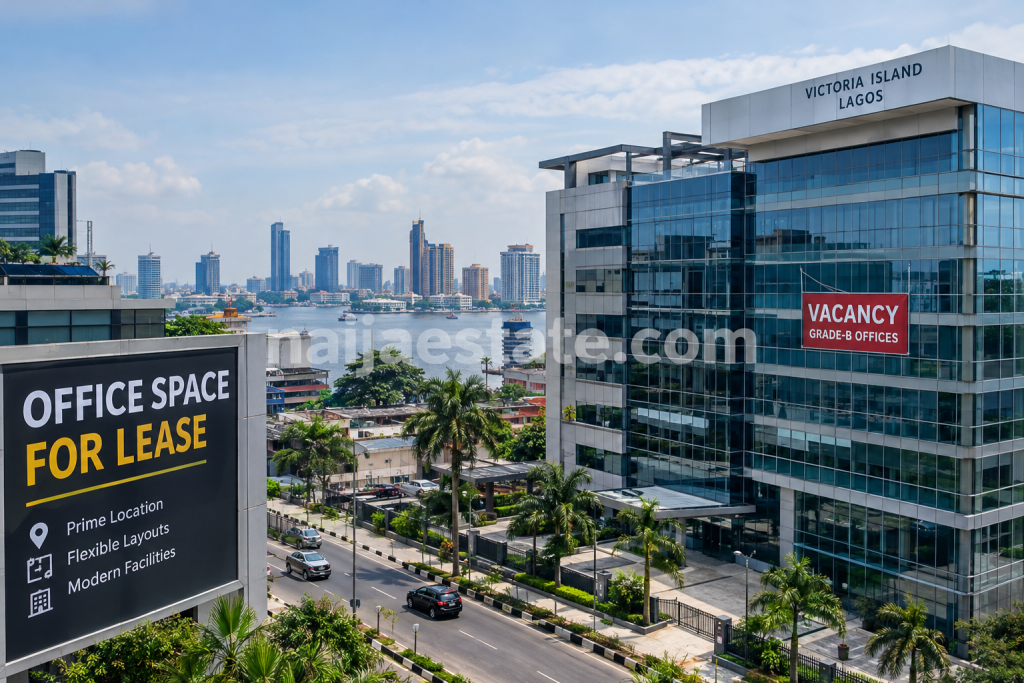
Commercial Office Space for Rent in Ibadan 2026: Why Older Offices Are Losing Tenants
NaijaEstate.com | Real Estate Market Insights | October 2026
Introduction: Is Your Commercial Property Becoming Too Expensive for Tenants?
Imagine owning a commercial building in Ibadan. You have several offices available for rent, the property is in a decent location, and you expect business owners to start calling as soon as you advertise it. But weeks pass, enquiries remain slow, and prospective tenants keep asking the same questions: Is there steady electricity? Where will my customers park? Can we negotiate the rent? Who pays for security and repairs?
This is the challenge facing landlords who want to attract tenants in today's changing commercial property market.
If you are searching for commercial office space for rent in Ibadan in 2026, the condition of a building, the cost of running a business there, and its accessibility can matter just as much as its location. A property does not automatically become attractive simply because it sits along a busy road.
Nigeria's wider office market is also changing. Reports published in 2025 and 2026 describe businesses reconsidering their space requirements and showing greater interest in efficient buildings, predictable operating costs, and flexible workspace arrangements. However, these national trends should not be mistaken for proof that Ibadan has the same vacancy rates or tenant preferences as Lagos. Ibadan has its own commercial districts, business mix, and affordability considerations.
In this guide, we examine what these changes could mean for commercial landlords, business owners, and property investors in Ibadan. We will look at the areas worth investigating, realistic rental-budget considerations, common leasing mistakes, property improvements that may attract tenants, and how to evaluate a commercial property before committing your money.
The aim is simple: help you make a better property decision without relying on hype or promises of guaranteed returns.
1. Why Older Commercial Offices May Be Losing Their Appeal in 2026
Not every older commercial building is struggling, and not every newly constructed property is a good investment. Nevertheless, an office that no longer meets its tenants' practical needs can become difficult to let, particularly when its rent does not reflect its limitations.
Here are five issues landlords in Ibadan should pay attention to.
1.1 The cost of electricity and backup power
Electricity is one of the first things many business owners consider when inspecting an office.
A small consulting firm may need electricity for computers, lighting, internet equipment, and air conditioning. A salon, design studio, medical practice, or printing business may have different power requirements, but the underlying concern is similar: unreliable electricity can disrupt operations and increase expenses.
Consider two hypothetical offices in the same part of Ibadan.
Office A has an attractive interior but relies entirely on an unreliable power supply.
Office B has a more modest finish but offers dependable wiring, a suitable backup-power arrangement, and transparent electricity charges.
A tenant who depends on uninterrupted work may prefer Office B, even if Office A looks more impressive during an inspection.
This does not mean every landlord must install an expensive solar system. The appropriate solution depends on the property's size, tenant profile, electrical load, and budget.
What landlords can do: Inspect the electrical installation, document the available backup-power arrangements, explain how shared electricity costs are calculated, and avoid promising 24-hour power unless the arrangement genuinely supports that claim.
1.2 High rent without corresponding value
The Nigerian property market has experienced substantial cost pressures, but landlords still need to distinguish between the amount they want to earn and the amount a suitable tenant is prepared to pay.
A building may have been purchased or developed when construction costs were lower. Its owner may now face higher maintenance bills, insurance expenses, security costs, and replacement costs for equipment.
Those expenses are real. However, a tenant also has to pay salaries, internet bills, transportation expenses, business taxes where applicable, and other operating costs.
If the rent and additional charges consume too much of the tenant's working capital, relocating to a smaller office or a different commercial district may become attractive.
Landlords should therefore assess the total cost of occupation rather than focus exclusively on annual rent.
1.3 Poor maintenance and ageing facilities
An older building can remain competitive if it is well maintained. Problems arise when the owner delays basic repairs for too long.
Examples include:
Leaking roofs and damp walls.
Faulty electrical sockets and exposed wiring.
Blocked drainage and unpleasant odours.
Broken windows and damaged doors.
Poorly maintained toilets and water systems.
Inadequate lighting around entrances and staircases.
Unreliable lifts in multi-storey properties.
A prospective tenant may interpret visible neglect as a warning about the way future repairs will be handled.
Nobody wants to move into an office only to spend the next three months calling the landlord about a leaking ceiling. As Nigerians say, wahala no dey finish—but avoidable building problems should not become part of a tenant's daily routine.
A practical improvement: Carry out a property-condition inspection before advertising the space. Prioritise safety, water ingress, electrical faults, sanitation, and other problems that could interfere with normal business operations.
1.4 Parking, access, and the customer experience
An office may be affordable and attractive but still unsuitable for a business that receives frequent visitors.
For example, an accounting practice, law firm, consultancy, or customer-service office may need convenient access for clients who prefer to drive. A building with limited parking can create difficulties, particularly if nearby roads are congested or parking restrictions apply.
The same issue affects deliveries. A business that regularly receives stock, documents, equipment, or supplies needs to consider loading access and the suitability of the surrounding road network.
In Ibadan, accessibility should be assessed at the specific property rather than assumed from the neighbourhood name alone. Two buildings within the same general district can offer very different experiences depending on their entrances, road conditions, setbacks, and available parking.
Before signing a lease, visit the property during the hours when your business is most likely to receive customers. A quiet Sunday inspection may not reveal the challenges you will encounter on a busy weekday.
1.5 Changing expectations about office space
The traditional idea of renting a large office for several years is no longer the only option available to businesses.
Some companies have adopted hybrid working arrangements. Others have reduced the number of permanent desks they need, while smaller firms may prefer serviced offices or shared workspaces that reduce their initial setup costs.
Nigeria's managed-office sector has received attention in recent industry reporting, particularly in Lagos, where flexible workspaces appeal to businesses seeking operational flexibility. That evidence establishes a wider market direction, not proof that every Ibadan business wants a coworking office.
For Ibadan landlords, the useful lesson is to understand the likely tenant rather than blindly copy a trend from another city.
A training company may need a large room on selected days. A small professional firm may want three private offices and a reception area. An online business may prioritise internet connectivity, power, and a modest monthly overhead.
The building that meets a particular business's needs at a reasonable total cost may be more competitive than a larger property with unnecessary space.
2. What the 2026 Office Market Means for Ibadan Property Owners
The conversation about older office buildings should not be reduced to the claim that all traditional offices are becoming obsolete.
Commercial property remains useful for businesses that need a physical address, customer-facing premises, staff collaboration, storage, or specialised facilities. The question is whether a property offers enough practical value to justify its price.
What national office-market reporting tells us
In June 2026, The Guardian reported on the growing divide between premium office buildings and older Grade-B stock in Lagos. The report described stronger demand for better-equipped buildings and pressure on some older properties as businesses reassessed their workspace needs.
Separately, BusinessDay reported in December 2025 on the shift towards smaller, more strategic office footprints and flexible arrangements amid economic uncertainty.
These reports are useful because they illustrate how tenants evaluate office space in a changing economy. However, landlords should not directly transfer Lagos rental benchmarks, vacancy statistics, or corporate leasing patterns to Ibadan.
Ibadan's commercial property market includes local professional practices, retail businesses, education-related enterprises, healthcare operators, distributors, service providers, and other organisations whose needs differ considerably.
For property owners, the more relevant questions are:
Is the asking rent competitive with genuinely comparable properties nearby?
Does the building meet the requirements of businesses that operate in the area?
Are electricity, security, water, parking, and maintenance arrangements clear?
Could a smaller unit or a different layout attract a wider pool of tenants?
Is the property being marketed to the right type of business?
These questions provide a better starting point than assuming that every older building is losing tenants for the same reason.
Grade-B offices: What does the term mean?
In commercial property, Grade A, Grade B, and Grade C are commonly used to describe differences in building quality, facilities, age, location, and overall market positioning.
However, classification practices can vary. There is no reason to assume that every commercial property advertised in Ibadan has been independently assessed against a uniform grading standard.
Broadly speaking, a Grade-B office might offer functional commercial accommodation without all the premium features associated with a top-tier office building. Depending on the property, it could have a conventional layout, older finishes, basic shared facilities, or less sophisticated building services.
That does not automatically make it a poor investment.
A modest office near its target customers may outperform an expensive premium building if the rent is appropriate and the facilities meet the tenant's needs.
The key issue is not the label. It is the relationship between condition, cost, location, and usefulness.
For Ibadan investors, this means inspecting the actual property and comparing it with alternatives instead of paying a premium for marketing language.
3. Which Areas of Ibadan Should Commercial Property Seekers Consider in 2026?
Choosing the right location is one of the most important decisions in commercial property leasing. However, the best location depends on what the business does, where its customers live or work, and how easily people can reach the premises.
The following areas are worth investigating. These are location-based considerations, not a verified ranking of rental growth or investment returns.

3.1 Bodija and Old Bodija
Bodija and Old Bodija are worth considering for professional services, consulting firms, selected retail businesses, and offices that benefit from access to established residential communities.
When assessing a property here, check the specific road, parking availability, surrounding land use, and whether the premises are legally suitable for the proposed business. Do not assume every residential building can automatically be converted into a commercial office.

3.2 Ring Road and the Oluyole corridor
Businesses looking for visibility and access to a wider commercial catchment may want to inspect suitable properties around Ring Road and parts of the Oluyole corridor.
These locations may be relevant for service businesses, showrooms, offices, and selected distribution activities. However, traffic exposure alone does not guarantee customers. Examine access from both directions, safe entry and exit, parking, drainage, and the exact location of the premises.

3.3 Jericho and Iyaganku
These areas are worth investigating for businesses seeking office accommodation within established urban districts.
Professional practices and customer-facing businesses should assess access, privacy, security, parking, and the suitability of the surrounding environment. Compare actual available premises rather than assuming that a prestigious address necessarily provides better value.

3.4 Akobo and the General Gas axis
Businesses that serve nearby residential communities may find this corridor worth exploring for appropriately located offices, neighbourhood services, and commercial units.
Check the visibility of the entrance, local parking conditions, power arrangements, drainage, and the proximity of your target customers. A lower rent is only an advantage if the location can support your business.

3.5 Oke Ado and central commercial districts
Businesses that depend on central-city accessibility, walk-in customers, trading activity, or proximity to established commercial services may wish to investigate Oke Ado and nearby districts.
The trade-off may involve congestion, limited parking, building condition, and the practical challenge of receiving deliveries. Visit at different times before deciding whether the location suits your operation.
How to choose between these locations
Use this simple framework before paying for an inspection or committing to a lease.
| Business type | What to prioritise |
|---|---|
| Consultancy or professional practice | Quiet environment, accessibility, privacy and reliable power |
| Retail showroom | Visibility, customer access, signage and parking |
| Training centre | Room layout, toilets, ventilation and public transport access |
| Distribution business | Loading access, vehicle movement, storage and road suitability |
| Small digital business | Internet options, backup power, security and affordable occupancy costs |
| Customer-service office | Convenient access, waiting area, sanitation and clear signage |
Treat this as a starting point, not a guarantee that any particular district will produce higher revenue.
For a broader view of commercial property investment outside Ibadan, you can also read NaijaEstate's article on where to buy commercial land for maximum ROI. Although the article focuses on Port Harcourt, the general lesson is relevant: evaluate the intended use, infrastructure, demand, and acquisition costs before choosing commercial land.
4. Commercial Office Space for Rent in Ibadan: What Do the Asking Prices Tell Us?
One of the biggest challenges facing prospective tenants is determining whether an advertised rent is reasonable.
Online property listings provide useful starting points, but they do not necessarily reveal the final negotiated rent, the quality of the building, or the additional charges a tenant will face.
As of October 2026, online listings show a wide range of commercial premises across Ibadan.
For example, PropertyPro Nigeria's listings include a modern office advertised at approximately ₦2.5 million per year around the Ring Road/Oke Ado area, alongside other commercial spaces at different price points. Nigeria Property Centre also publishes commercial rental listings for Ibadan. These are asking prices for individual advertised properties, not a complete survey of completed lease transactions.
To understand the implications, consider three hypothetical office options.
Option A: Basic office
₦1.5m/year
Illustrative assumption, not a current verified listing
A small office with basic facilities and limited backup power. The headline rent is affordable, but the tenant may need to spend money on equipment or improvements.
Option B: Functional office
₦2.5m/year
Illustrative assumption informed by a comparable advertised price point
An office with a workable layout, reasonable access, and clearly defined shared facilities. It may offer better value if it requires fewer additional expenses.
Option C: Larger commercial premises
₦5m/year
Illustrative assumption, not a market average
A larger space suited to a business with more staff, equipment, or customer traffic. It may be unnecessary for a small operation.
The figures above are examples for comparing budgets, not a claim that these three options are available in the same neighbourhood or offer equivalent facilities.
Why the cheapest office may not be the cheapest option
Suppose a business rents an office for ₦1.5 million per year but spends another ₦700,000 on necessary improvements, backup-power equipment, and other setup expenses.
Its initial cash requirement is already ₦2.2 million before considering any agency fee, legal fee, service charge, or other applicable costs.
A second office with a higher rent could turn out to be more economical if it is ready for occupation and has lower operating expenses.
The reverse is also possible. A premium office can be a poor choice if the business does not need its additional facilities.
The correct comparison is therefore based on the total cost of occupation, not rent alone.
Calculate the real cost before signing
Use this simple formula:
For example, assume a hypothetical tenant is considering an office at ₦2.5 million annually.
| Cost item | Illustrative amount |
|---|---|
| Annual rent | ₦2,500,000 |
| Agency fee, assumed at 10% | ₦250,000 |
| Legal fee, assumed at 5% | ₦125,000 |
| Initial setup | ₦300,000 |
| First-year service charges | ₦240,000 |
| Total initial-year cost | ₦3,415,000 |
The agency and legal percentages above are assumptions for this example, not mandatory statutory rates or a statement of standard market practice. Actual charges depend on the agreement, the services provided, and applicable law. The service-charge figure is also hypothetical.
In this example, the tenant needs ₦3.415 million rather than the advertised ₦2.5 million to cover the listed first-year costs.
That difference can materially affect the affordability of a lease.
Before paying, ask for a written breakdown covering rent, deposits, agency and legal charges, service charges, electricity, water, security, maintenance, and any applicable taxes.
Also establish whether each payment is refundable, how increases will be handled, and what happens if the landlord fails to provide an agreed service.
5. Why Tenants Leave Older Offices: The Hidden Costs Landlords Often Overlook
When a tenant leaves, the landlord may assume the problem is simply the price of rent. Sometimes it is. But other issues can influence the decision.
The following examples are hypothetical scenarios designed to illustrate common commercial leasing problems. They are not presented as interviews with actual Ibadan tenants or as measured vacancy statistics.
Case study 1: The landlord who increased rent without reviewing the property
Imagine a landlord operating a small office building in Ibadan. The building has been occupied for several years, and the owner decides to increase rent because maintenance expenses have risen.
The landlord's reasoning is understandable: repairs, replacement materials, and building services cost money.
However, the building still has recurring water problems, inadequate parking, and an unreliable electricity arrangement. Tenants begin comparing it with nearby alternatives.
The issue is no longer simply whether the increase is affordable. It is whether the additional cost offers any corresponding improvement in value.
The lesson: Before raising rent, review the building's condition, local alternatives, tenant feedback, and total cost of occupation. Improvements do not guarantee retention, but neglect can make an increase harder to justify.
Case study 2: The attractive building with expensive operating costs
Consider a second property with a modern interior, tiled floors, air conditioning, and a neat reception area.
During inspections, prospective tenants are impressed. But once they ask about electricity, security, water, waste collection, and common-area maintenance, the overall cost becomes less attractive.
A business that initially considered the office may decide to rent a smaller space instead.
This is a reminder that visual appeal and operational value are different things.
A building's appearance can attract enquiries, but the everyday cost of using it may determine whether a tenant signs and stays.
The lesson: Landlords should explain operating expenses early and provide realistic estimates wherever possible. Tenants should request written details rather than rely on verbal assurances.
Case study 3: The oversized office that no longer fits the tenant
Imagine a small company that initially rents a large office for a team of 20 people. Over time, some staff members work remotely, the business reorganises, and fewer employees need permanent desks.
The office becomes unnecessarily expensive.
The tenant may ask to reduce the rented area, negotiate a new arrangement, or move to a smaller property.
A landlord who is unwilling to consider reasonable alternatives may lose the tenant entirely.
The lesson: Where the building's design permits it, landlords can explore dividing suitable floor areas into smaller units, subject to planning, building-safety, and other applicable requirements.
The objective is not to accommodate every request. It is to consider whether a practical arrangement could generate more reliable income than leaving the entire space vacant.
6. How Landlords Can Make Older Commercial Properties More Competitive
A landlord does not always need to demolish an old building or spend millions on luxury finishes to improve its attractiveness.
In many cases, a carefully prioritised maintenance programme and clearer leasing terms can make a meaningful difference.
Step 1: Repair essential facilities first
Start with issues that affect safety and daily operations.
These may include:
Electrical faults and unsafe wiring.
Roof leaks and water damage.
Poor drainage and sanitation.
Broken doors, locks, and windows.
Faulty plumbing and water supply.
Inadequate emergency exits or fire-safety provisions.
Damaged access paths and poorly lit common areas.
Use qualified professionals for electrical, structural, and other specialised work. Cosmetic improvements should not take priority over serious safety defects.
Step 2: Improve the power arrangement
Rather than installing the most expensive system available, establish what the intended tenants actually need.
A small administrative office may require a different solution from a business operating computers, refrigeration equipment, or heavy machinery.
Consider whether the building can support:
Properly installed backup-power equipment.
Solar power where technically and financially suitable.
Safe electrical distribution and metering.
Clear rules for shared electricity costs.
Reasonable energy efficiency in lighting and cooling.
Explain exactly what is included in the rent and what the tenant must pay separately.
Step 3: Offer practical layouts
Not every business wants a large open-plan office.
Some tenants need private rooms for confidential meetings. Others want an open workspace with a reception desk, a meeting room, and a few workstations.
If the building permits alterations, consider whether it can accommodate different business requirements without compromising safety or approved use.
Smaller units can broaden the pool of prospective tenants, although subdivision only makes sense when the cost of modifications, common facilities, and management is financially justified.
Step 4: Treat parking and security as part of the product
A secure office building is more than a gate and a security guard.
Tenants may want to understand access control, visitor procedures, lighting, emergency arrangements, and responsibility for shared spaces.
Security charges should be clearly explained, especially where tenants are expected to contribute to a shared arrangement.
NaijaEstate has published a related guide on unreasonable estate security levies in Nigeria and what resident associations can legally do. Although that article addresses estate levies rather than commercial office leases specifically, it reinforces an important principle: property-related charges should be transparent, properly explained, and assessed in their actual legal context.
Step 5: Market the property accurately
An advert that says "luxury office in a prime location" tells a prospective tenant very little.
A useful listing should include:
The exact neighbourhood and a clear location description.
Floor area, room configuration, and available facilities.
Annual rent and payment terms.
Parking availability and access conditions.
Electricity and water arrangements.
Security and service charges.
The permitted or approved use, where relevant.
Recent photographs that accurately represent the premises.
Accurate details can reduce unsuitable enquiries and help tenants compare properties.
If you are advertising commercial property, avoid describing a building as fully serviced or continuously powered unless those claims can be substantiated.
Step 6: Consider flexible lease arrangements carefully
Some tenants may prefer shorter commitments, smaller spaces, or clearly defined renewal options.
A landlord can assess whether offering a different lease structure makes commercial sense. However, flexibility should not mean leaving important terms vague.
The agreement should address rent reviews, payment dates, maintenance responsibilities, deposits, alterations, permitted use, termination, renewal, and any conditions governing early exit.
Seek qualified legal advice when drafting or revising a commercial lease.
7. How Tenants Can Avoid Expensive Commercial Leasing Mistakes in Ibadan
Landlords are not the only people who need to adapt. Tenants also need to make careful decisions before committing funds.
A property can look attractive during an inspection while hiding problems that become obvious only after occupation.
Use this checklist before paying a deposit or rent.
Commercial property inspection checklist
Tick each item as you verify it during your inspection.
0 of 10 completed
Be careful with property documentation
Before leasing a commercial property, verify who has the legal authority to grant the tenancy. Depending on the circumstances, relevant documents may include the title documents, ownership records, a valid power of attorney, or evidence of authority from the property owner.
The documents needed will depend on the transaction. Do not assume that seeing a photocopy of a Certificate of Occupancy (C of O) settles every ownership or authority question.
Where the transaction involves substantial rent, significant renovation costs, or a long lease, consider engaging a qualified Nigerian property lawyer to review the documents and agreement.
Also confirm that the proposed use is permitted under applicable planning and building requirements. A building's previous use does not automatically establish that every new commercial use is lawful.
Don't ignore the lease agreement
Before signing, check the following clauses carefully:
Rent review: How and when can rent increase?
Repairs: Who is responsible for structural repairs, plumbing, electrical work, and routine maintenance?
Service charges: What services are included, how are charges calculated, and how are additional expenses approved?
Alterations: Can the tenant install partitions, signage, air conditioning, or backup-power equipment?
Termination: What notice is required, and what circumstances allow either party to terminate?
Renewal: Is renewal automatic, conditional, or subject to a new agreement?
Deposit: What deductions are permitted, and when should the balance be refunded?
A written agreement is particularly important where the tenant will invest money in fitting out the premises.
For a more flexible workspace, you may also find NaijaEstate's article on office space for remote work in Lagos useful for understanding the wider conversation about workspace arrangements. Its Lagos focus means that pricing and local-market assumptions should not be transferred directly to Ibadan.
8. Is Buying Commercial Property in Ibadan Better Than Renting It?
This is a common question among business owners and property investors. There is no universal answer because buying and renting serve different financial purposes.
Renting can preserve capital for inventory, staff, equipment, marketing, and business expansion. Buying may offer greater control over the premises and potential long-term property appreciation, but it requires substantial upfront capital and ongoing responsibility for ownership-related expenses.
When renting may make more sense
Renting could be the more practical option when:
Your business is still growing and its future space requirements are uncertain.
You need to preserve cash for daily operations.
You are testing a new neighbourhood or customer base.
You want to avoid committing capital to a building that may not suit your future needs.
The purchase price is high relative to the income your business can reasonably generate.
When buying may deserve consideration
Purchasing a commercial property may be worth investigating if:
Your business has stable, long-term premises requirements.
You have sufficient capital after accounting for working capital and other obligations.
The property has been properly assessed and its title and permitted use have been verified.
You can afford maintenance, security, taxes where applicable, and other ownership costs.
The purchase makes financial sense compared with renting a suitable alternative.
Investors considering commercial land should also examine access roads, drainage, utilities, planning restrictions, title history, and the cost of developing the site.
Do not buy land simply because an agent says the area will soon become the next major commercial hub. Future development is not guaranteed, and infrastructure announcements do not automatically translate into profitable property investments.
For additional context, NaijaEstate's article on affordable housing in Ogun State on a payment plan discusses a different part of the property market, but it may help readers think more carefully about payment structures and affordability before committing to a property purchase.
9. How to Calculate Whether a Commercial Property Investment Is Worth It
For investors, the most important question is not simply how much rent a property can command. It is how much income remains after relevant expenses and periods without a tenant.
Consider a hypothetical commercial property in Ibadan.
Assume the property costs ₦60 million to acquire and is expected to generate ₦6 million in annual rent when fully occupied.
The headline rental yield would be:
That 10% figure is a gross yield, not a guaranteed return.
Now assume the property incurs the following annual expenses.
| Item | Illustrative annual amount |
|---|---|
| Potential rent at full occupancy | ₦6,000,000 |
| Maintenance and repairs | ₦600,000 |
| Owner-paid management and common expenses | ₦300,000 |
| Other owner-paid operating expenses | ₦300,000 |
| Income before financing and other costs | ₦4,800,000 |
Based on these assumptions, the income remaining before financing costs and other excluded expenses would be ₦4.8 million.
Compared with the ₦60 million purchase price, that represents an illustrative yield of 8% before financing, acquisition costs, applicable taxes, and any other expenses not included in the calculation.
The calculation also assumes full rent collection and occupancy. If the building remains vacant for part of the year, the actual income may be lower.
Why tenant retention matters
Suppose a landlord spends money renovating an office but still cannot attract a suitable tenant. The property generates no rent during the vacancy period, yet many ownership expenses continue.
Even a property with an attractive headline yield can disappoint if it experiences frequent tenant turnover, prolonged vacancies, unpaid rent, or unexpected repairs.
Investors should therefore evaluate:
Realistic achievable rent, rather than the highest advertised rent.
Likely vacancy periods.
The condition and remaining useful life of major building components.
The cost of improvements required before occupation.
Tenant demand for the particular type of space.
The quality of the property's legal documentation.
The effect of financing and acquisition expenses on returns.
Where possible, compare multiple similar properties and use documented rent and expense information. Online listings can help identify asking-price ranges, but they do not establish the income an investor will actually receive.
10. How NaijaEstate Can Help You Research Commercial Property Opportunities
Finding a suitable commercial property involves more than scrolling through photographs and choosing the lowest price.
A business owner needs to understand location, access, permitted use, total leasing costs, and the condition of the premises. An investor also needs to assess ownership documentation, likely demand, maintenance requirements, and the financial viability of the property.
NaijaEstate can serve as a starting point for researching Nigerian property opportunities and keeping up with real estate developments.
You can explore the NaijaEstate property news section for articles on property investment, affordability, property-related charges, and other issues that affect buyers, landlords, and tenants.
When researching a commercial property, use listings to create a shortlist rather than treating an advertisement as proof that a property is suitable or legally sound.
A practical approach is to:
Identify two or three neighbourhoods that fit your business requirements.
Compare available properties with similar sizes and facilities.
Request the complete rental and service-charge breakdown.
Arrange physical inspections and assess the property during working hours.
Verify ownership or leasing authority and relevant approvals.
Have the lease reviewed before committing substantial funds.
Compare the total cost of each option before making your final decision.
This process can help you avoid spending valuable time inspecting properties that are unsuitable for your needs.
11. What Could the Ibadan Commercial Property Market Look Like Beyond 2026?
No responsible market analysis should promise that commercial rents will rise, that vacancies will disappear, or that a particular neighbourhood will deliver guaranteed investment returns.
The future of commercial property in Ibadan will depend on several factors, including business activity, household and company budgets, infrastructure, construction costs, interest rates, access to finance, and the supply of suitable premises.
Nevertheless, several practical considerations deserve attention.
Functional buildings may have an advantage
Properties that combine reasonable rents with dependable facilities may appeal to businesses that cannot justify the cost of premium offices.
This does not mean that luxury buildings will lose all their tenants. Rather, it suggests that landlords should understand the relationship between their asking rent and the value their buildings provide.
Flexible space may suit selected businesses
Smaller offices, divisible units, and serviced workspace arrangements may be appropriate for some tenants, particularly businesses with changing staffing needs or limited initial capital.
However, landlords should establish whether there is sufficient demand in their specific location before investing in a conversion.
Operating costs will remain an important consideration
Electricity, repairs, security, water, and other expenses affect both the landlord's finances and the tenant's budget.
Properties with clear billing arrangements and well-maintained facilities may be easier for prospective tenants to assess.
Location will continue to matter, but not in isolation
A visible location may help a retail business, while a quieter and more affordable street may be suitable for a consultancy.
There is no single best commercial property location for every business. The right choice depends on customer behaviour, operating requirements, access, and affordability.
Better information can improve property decisions
Property seekers should compare more than advertised rent. They should also assess building condition, legal documentation, maintenance responsibilities, and the total cost of occupation.
For landlords, recording enquiries, inspection feedback, reasons tenants leave, and the time each unit remains vacant can provide more useful information than relying on assumptions about what tenants want.
These are practical ways to make better decisions in an uncertain market, even when reliable neighbourhood-level vacancy statistics are unavailable.
Conclusion: The Best Commercial Property Is the One That Works for Its Tenant
The changing conversation around commercial real estate offers an important lesson for Ibadan landlords and property investors: an office building's value is not determined by its appearance or asking rent alone.
Tenants need premises that support their businesses without creating unnecessary financial pressure. They want reasonable rent, reliable facilities, accessible locations, transparent charges, and landlords who take maintenance seriously.
For property owners, this means reviewing the condition of older buildings, understanding the needs of prospective tenants, and making improvements that are financially sensible. For tenants, it means looking beyond attractive photographs and checking the full cost of occupation before signing a lease.
For investors, it means calculating realistic rental income, accounting for vacancies, and verifying ownership and planning requirements before committing substantial capital.
Ibadan offers a range of commercial property options, but the right choice depends on your business, budget, location requirements, and investment objectives. Careful research is more valuable than assuming that a particular neighbourhood or property type will automatically produce strong returns.
Now, let's hear your opinion: If you were choosing an office in Ibadan today, which would matter most to you: affordable rent, reliable electricity, convenient parking, or a prime location?
Share your thoughts in the comments, and explore more Nigerian real estate insights on NaijaEstate.com.

